


Turn Anonymous Stakeholders into Engaged Capital Market Relationships
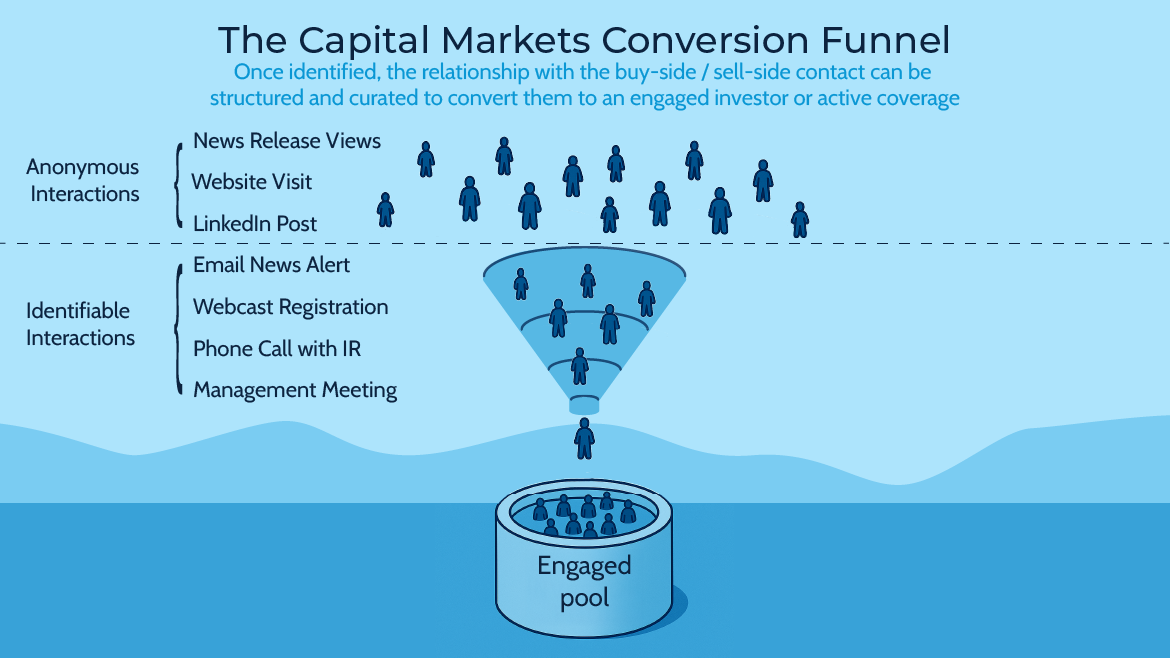
In today’s capital-markets, it is insufficient for a public company to simply publish news and host conference calls. Basic communications will not unlock your company’s unrealized shareholder value. To go beyond basic communications, companies must think strategically about how they convert previously anonymous stakeholders into engaged contacts. Modern capital market programs require an capital markets conversion funnel to systematically capture, nurture, and convert interest into meaningful relationships.
Why Conversion Funnels Matter
In marketing a conversion funnel is the journey a prospect takes from first awareness to a final action. The typical stages are Awareness → Interest → Consideration → Action. Applied to the capital markets, the “customer” is the prospective investor, sell-side analyst, retail broker, corporate access professional, sales desk, and media. Basically, any actor in the capital markets who may ultimately drive investment, coverage, or access. If you fail to map and optimize the conversion funnel, you leave unrealized shareholder value on the table.
Stages of the Conversion Funnel
Awareness / Entry
At the top of the funnel, the goal is to turn anonymous individuals into identifiable leads. In the capital markets context, this means a sell-side analyst, potential investor, or media contact who knows nothing of your company. The top of the capital markets funnel is where these actors begin to engage: visiting your IR website, reviewing a news release, visiting the company’s LinkedIn page, or scanning your earnings reports. Yet anonymous interactions are of no value unless until these actors convert into known contacts.
Interest / Capture
The key is to convert the anonymous interactions into identifiable engagement. This occurs when a participant subscribes to an email news alert, registers for a webcast, calls or emails the IR office, or requests a meeting with management. To effectively accomplish this task, the company must:
- Provide clear calls to action to enter the conversion funnel. For example, the corporate website should feature a clear call to subscribe to the company’s email news alerts above the fold on the landing page (without using intrusive pop-ups);
- Ensure the identifiable engagement is actually captured. Too many companies fail to extract essential contact information when the opportunity presents itself. For inbound emails and phone calls, the company’s point of contact needs to consistently capture the name and phone number of callers and add contacts to the email news alert. If capital market interactions are being managed by an executive assistant, the chances that this critical opportunity is being missed are nearly 100%.
- All of this information needs to be captured in an investor relationship management system otherwise it will be lost. Companies need to deploy a robust investor relationship management system to curate and manage the relationships that are now in the capital markets conversion funnel. Managing your capital market relationships through an excel spreadsheet is an invitation to disaster.
Unfortunately, most companies fail in one or all of these areas, compromising the capital markets conversion funnel.
Consideration / Engagement
Once a company has captured the contact, it must nurture the relationship. That means timely email alerts, webcast invitations, meaningful management access, follow-up calls and relevant content. Just as marketing funnels track drop-off between stages, companies should monitor where participants disengage. (e.g., they subscribe but never open alerts, register for a webcast but don’t attend, meet management but don’t ultimately invest (buy-side) or fail to launch research coverage (sell-side)).
Action / Conversion
The final goal is converting the contact into a value-creating capital-markets contact. That may mean initiating coverage (for sell-side analysts), placing capital (for the buy-side), or becoming an influential media source. Anything that interferes with a stakeholder entering the top of the conversion funnel is detrimental to the company’s market value. Ensuring seamless entry and progression is critical.
Best Practices for Optimizing Your Conversion Funnel
- Make every top-of-funnel step trackable and friction-free. Whether it’s a webcast registration or email-alert subscription, ensure the form is minimal. Data capture should be easy and swift with a clear call-to-action (“CTA”).
- Measure drop-offs and leaks. Marketing firms use funnel-analysis tools to spot the largest drop-off step. Capital market engagement teams should similarly monitor where contacts drop out. The email news alert can be a significant source of leakage. Please review our article on how to ensure you are not hemorrhaging engaged contacts from your email news alert system.
- Segment and personalize. Capital market communications should tailor engagement to investors vs. analysts vs media vs bankers.
- Remove blocking points at the top. Poor website navigation, non-intuitive webcast registration, or lack of a clear news-alert CTA can block entry into the funnel. These top-of-funnel blockages degrade your conversion rates, weaken your capital-markets program, and by extension harm your company’s market value.
Final Thought
A well-designed capital market conversion funnel turns anonymous stakeholders into trackable relationships. This allows your capital markets program to nurture these relationships and ultimately drive outcomes. Companies should apply the same sales-funnel-thinking to build a dynamic engine for investor and analyst engagement.
If your company is unsure of whether it has a functional capital markets conversion funnel, or needs help to deploy one, we can help. MCI’s Digital and Artificial Intelligence Technologies Services will ensure you are maximizing your potential engagement with the market.
Frequently Asked Questions
What is an capital markets conversion funnel?
A capital markets conversion funnel is a defined system and process that converts anonymous stakeholders into engaged participants. It applies to prospective investors, sell-side analysts, retail brokers, corporate access teams, sales desks, media and other actors in the capital markets who may ultimately drive investment, coverage or access.
Why do companies need a capital markets conversion funnel?
A failure to convert anonymous stakeholders into engaged participants weakens your company’s capital-markets program and, by extension, harms your company’s market value. It also degrades the company’s pool of engaged contacts that are needed in the event of a proxy challenge brought on by an activist shareholder or other entity. A company’s engaged investor pool is a critical differentiator during a proxy contest.